
Navigating Malaysia’s Revised Financial Advertising Guidelines: Fin-Influencer legal Ramifications.
Malaysia’s Securities Commission (SC) has refreshed its financial advertising rules to curb undisclosed promotions, “get-rich-quick” pitches, and commission-driven funneling into high-risk products by unlicensed parties. That’s a healthy clean-up for market integrity. But it has also spooked legitimate crypto builders who don’t take client money and don’t sell securities.
This piece separates signal from noise. We steel-man the regulator’s view (take it at its strongest), then straw-man the edges (clarify where non-custodial tech firms sit comfortably outside brokerage-style triggers), and end with a practical posture for operating confidently.
But Here’s Why Legitimate Non-Custodial Crypto Firms Are in a Good Place

Let’s steel-man (i.e., accept the force of the regulation) and then straw-man (i.e., test where legitimate firms fall outside the regulatory trigger) the framework.
We propose a more nuanced, fact-based, and optimistic view – especially for legitimate non-custodial crypto infrastructure companies that do not accept client funds, do not promise guaranteed returns, and simply facilitate interaction with blockchain systems, staking, liquidity-mining, and decentralized protocols. In that context, the revised rules are more an opportunity for clarity and differentiation than a wall of prohibition.
What the regulator is rightly targeting:
- Undisclosed promotions & finfluencer ads that look independent but are paid.
- Commission/affiliate funnels that drive Malaysians to unlicensed brokers for CFDs/FX/derivatives.
- Promises of returns and exaggerated claims without risk disclosure.
- Hidden risks & opaque schemes that blur who holds client funds and who is accountable.
This is about protecting retail investors from misleading conduct by actors that, in substance, behave like brokers or investment advisers.
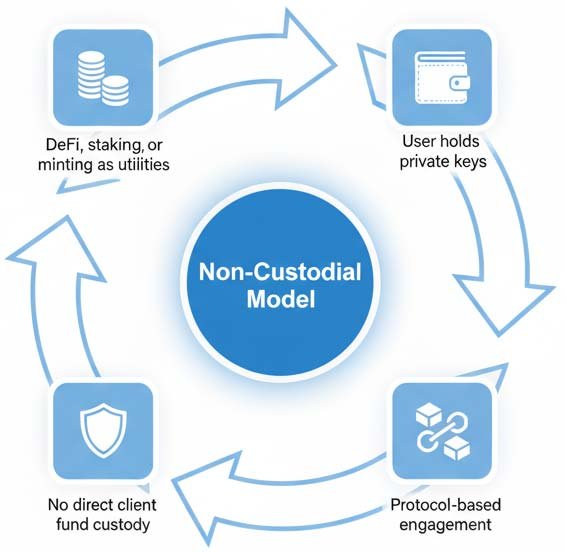
Where non-custodial firms cleanly differentiate:
How to spot the scam/ money-game/ ponzi /pump & dumps ?
| Topic | 🚩 Scam Red Flags | ✅ Legit Green Flags |
|---|---|---|
| 1) Custody & Control | You must deposit to them; they “manage” funds; withdrawal hoops | Non-custodial: you hold the keys; you sign every tx; provider never holds client funds |
| 2) Exit / Divest Rights (On-chain) | Lock-ins, excuses, approvals, “cool-downs,” new fees to withdraw | You can divest anytime via your wallet; exits are enforced by smart contracts/on-chain, not staff discretion (subject to protocol rules & gas) |
| 3) Claims & Promises | “Guaranteed,” “risk-free,” fixed daily ROI/APY, FOMO/celebs | No guarantees; balanced risk disclosures; past data shown with caveats |
| 4) Fees & Incentives | MLM/referral bounties, deposit bonuses, hidden spreads | Simple, public fee table; no payouts tied to trading volume or your losses |
| 5) Transparency (“Show the rails”) | Opaque “internal ledger,” no audit/contract links, anonymous team | Contract addresses, explorer links, audits, docs, named team, clear terms & regions served |
Why this is good news for legitimate companies and bad news for scams?
The revised rules don’t outlaw responsible crypto infrastructure. They differentiate. Separates the wheat from the chaff. Malignant actors who promise improbable high gains and take full custody of your funds while promising a fixed (or variable) return based on a mixed bag of nuts of buzzwords like “AI” or “Algo” or “Quant” trading….are highly suspect. Those who continue to disseminate messages promoting these type of sketchy and questionable programs have to wise up and divest all interest in said programs or risk being under the radar of SC. Ignore at your peril.
The Bottom line
For non-custodial firms—where users keep their assets, sign their own transactions, and you neither accept deposits nor promise performance—the SC’s advertising refresh is not a jurisdictional trap; it’s a clarifier. You are not offering brokerage-style “capital market services,” and you are not marketing a packaged “capital market product.” Your role is technology facilitation, not client-fund intermediation.
That places you outside the typical triggers that pull brokers and advisers into the SC’s licensing and advertising net. Embrace that distinction, design your flows and disclosures to make it undeniable, and market responsibly. Do that, and you’ll navigate the new landscape with confidence—not fear—while standing out as the credible, user-protective option in a market that now rewards exactly that.
Concluding Thoughts
While the revised rules of the SC introduce stricter oversight and higher penalties, that does not mean all marketing activity in the crypto/protocol space is foreclosed. On the contrary: firms that are transparent, non-custodial, technology-centric, and avoid the hallmarks of “brokerage + client funds + guaranteed returns” are well placed to operate in this environment — and actually stand out as trustworthy players.
The regulatory shift can be viewed less as a chilling blanket and more as a market differentiation lever: those who comply will gain trust, those who cut corners will be exposed. For GIS, by emphasizing your strong legal awareness, your non-custodial architecture, and your alignment with investor/user protection, you signal upstream maturity — and that will resonate with partners, users, and regulators alike.
In short: understand the law, design accordingly, market responsibly — and you will navigate the new landscape not with fear, but with confidence.